


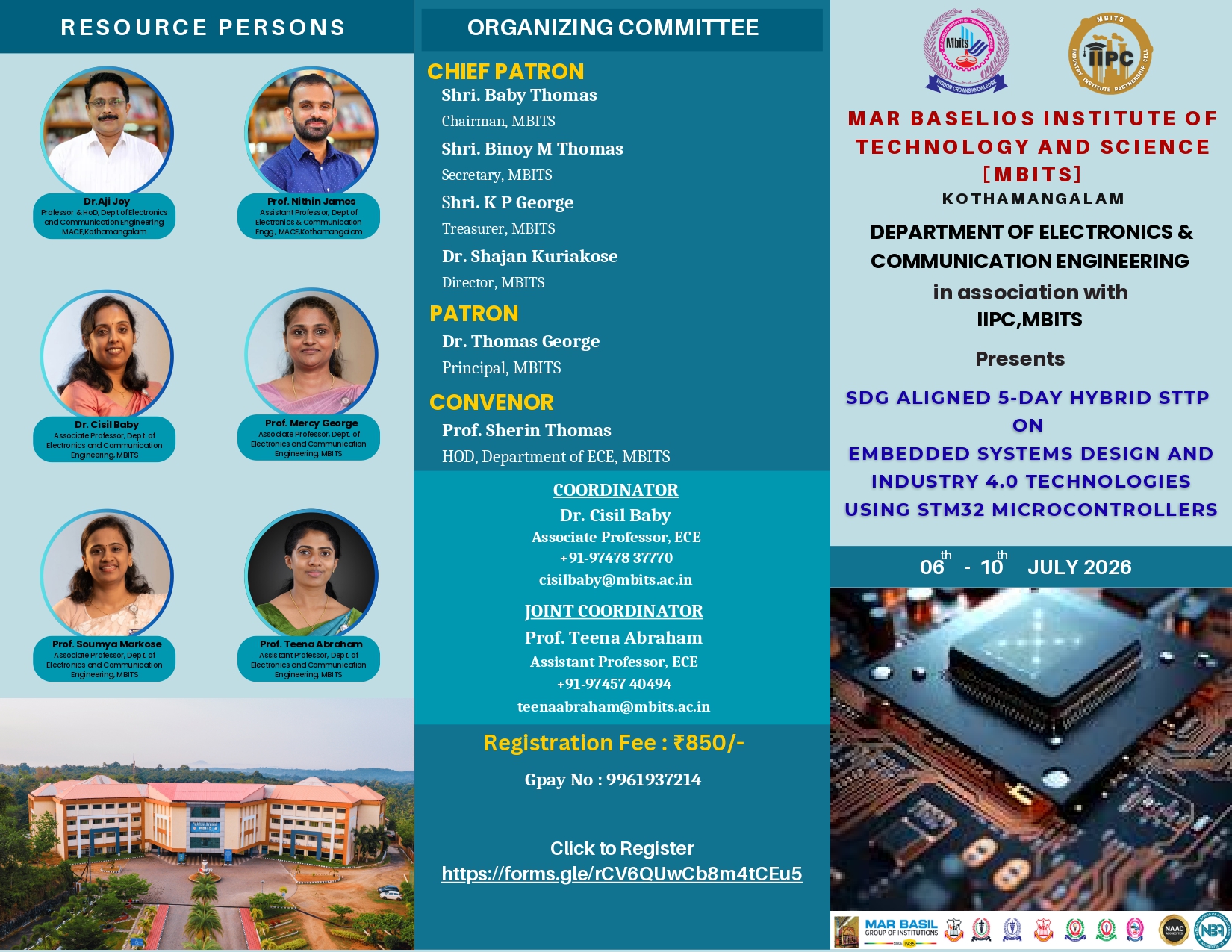
The 5-Day Hybrid STTP was organized during 6th July 2026 to 10th July 2026 from 9:30 AM – 4:30 PM. The sessions were conducted by
Prof. Nithin James, Assistant Professor, MACE
Dr. Aji Joy, Professor & HoD, MACE
Dr. Cisil Baby, Associate Professor, MBITS
Prof. Soumya Markose, Associate Professor, MBITS
Prof. Mercy George, Associate Professor, MBITS
Prof. Teena Abraham, Assistant Professor, MBITS
A total of 34 members, including Faculty Members, Research Scholars, Postgraduate (PG) Students and Undergraduate (UG) Students from various colleges actively participated in the event.
The primary objective of the STTP was to provide participants with a strong foundation in embedded system design using STM32 ARM Cortex-M4 microcontrollers while enhancing their practical knowledge through structured laboratory sessions. The programme aimed to bridge the gap between classroom learning and industrial requirements by providing hands-on training in embedded programming, hardware interfacing, communication protocols, real-time application development, and embedded software debugging. It also focused on improving participants' understanding of modern embedded technologies and their applications across various engineering domains.
The STTP covered ARM Cortex-M4 architecture, STM32CubeIDE, GPIO programming, interrupts, timers, ADC/DAC interfacing, communication protocols such as USART, I²C and SPI, sensor interfacing, real-time embedded system development, and industrial applications of embedded systems. Participants also gained exposure to IoT, robotics, automation, and Industry 4.0 technologies, enabling them to understand current industrial practices and strengthen their practical skills through project-oriented learning and experimentation.
The programme also strengthened participants' ability to apply embedded technologies in emerging domains such as IoT, robotics, industrial automation, and Industry 4.0. It enhanced their technical competency, critical thinking, teamwork, communication, project planning, and innovation skills while providing valuable exposure to industrial practices and modern engineering tools. As a result, the participants became better equipped to undertake research activities, develop industry-oriented projects, and pursue professional careers in embedded systems and intelligent technologies.